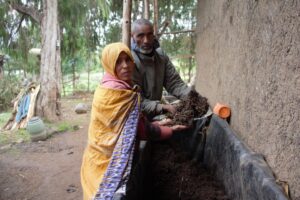
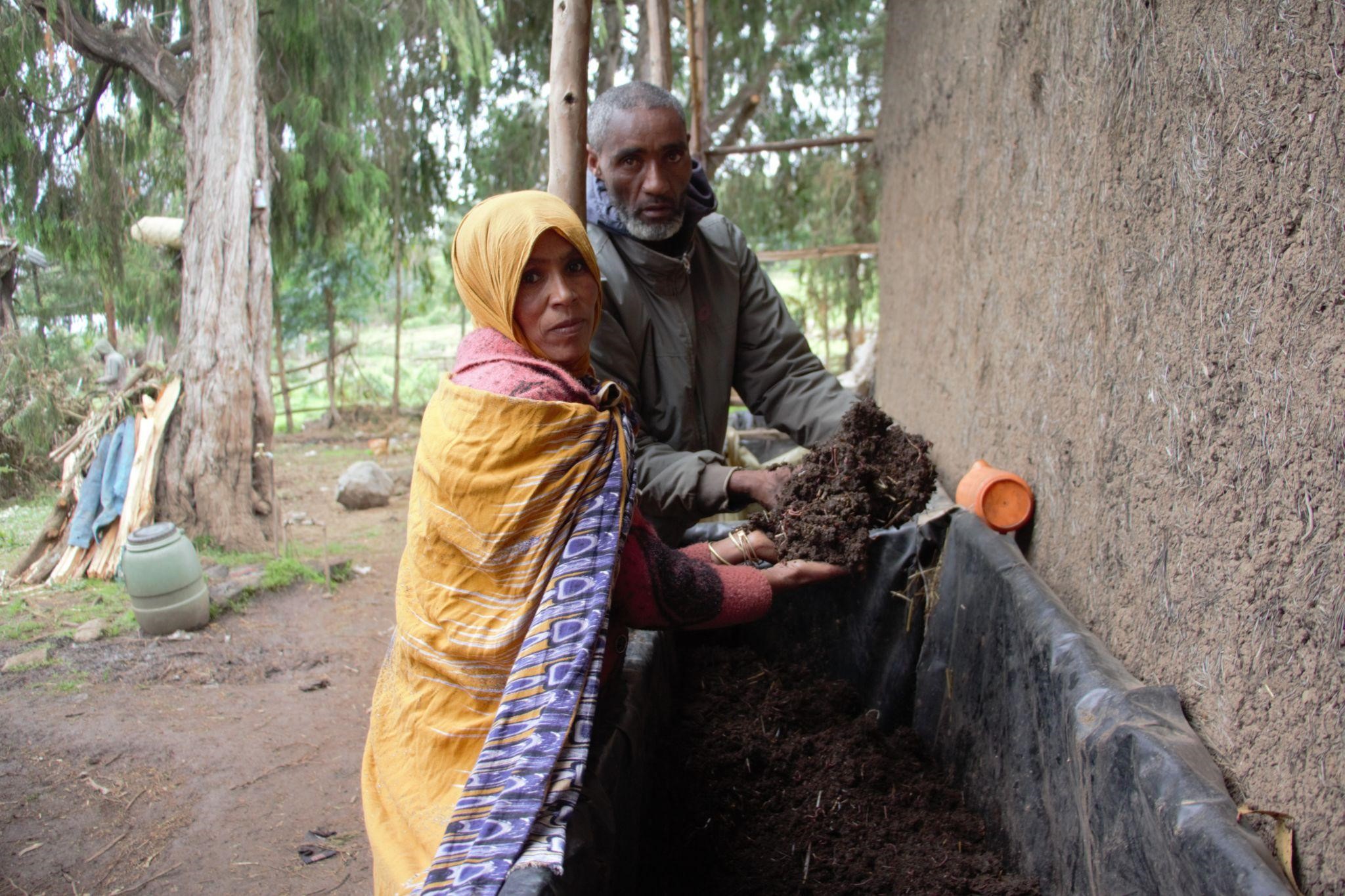
Mr Abdurahman Aman with his wife in their backyard
Abdurahman Aman, a 45-year-old farmer from Karari Kebele in Dinsho District, Bale Zone, is one of many farmers in the area learning to adapt to shifting rainfall patterns and declining soil fertility. He is a father of four, and for years he struggled with falling barley and wheat yields and the rising costs of chemical fertilizers. Abdurahman shared his journey: “Before 2022, life was difficult. Our harvests were shrinking every year, and we spent more money on fertilizers, yet the results were never enough. I worried about feeding my family and keeping our land productive. I didn’t know that there was another way.”
Mr Abdurahman Aman with his wife in their backyard
That changed when he joined a project supported by the Swedish Society for Nature Conservation and implemented by MELCA Ethiopia. The initiative promotes resilience through ecological farming and soil rehabilitation. “Through training from MELCA Ethiopia and our development agents, I learned about vermicomposting. They showed me how to make and manage compost at home. It seemed simple, but I didn’t realize how much it could change our farm.” With guidance and consistent follow-up, Abdurahman applied organic inputs to his vegetables and staple crops. “By 2023, I harvested five quintals of barley with much better grain quality than in previous years. My wife and I earned extra income from cabbage grown in our backyard with organic compost, and we even sold composting worms. My wife bought sheep with the income, which strengthened our household’s assets.” Mr Abdurahman Aman with his wife in their backyard in Karari Mr Abdurahman Aman with his wife in their backyard in Karari